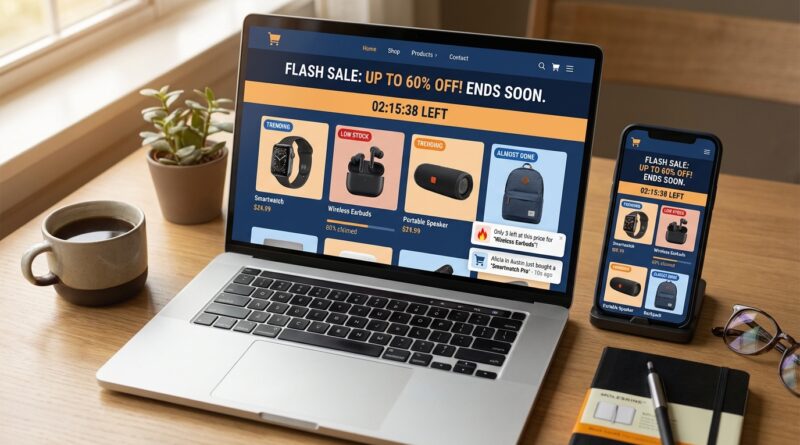
The ‘Real-Time Proof’ Flash Sale: Turn Live Purchase Signals Into Instant Trust On Every Page
You can feel the pain of a flash sale that should work, but does not. The traffic arrives. People click. They even add to cart. Then checkout turns into a ghost town. That usually means the price is not the real problem. Trust is. Shoppers see a timer, a discount, maybe a bright red banner, and instead of feeling urgency, they wonder if the whole thing is a bit fake. That hesitation is expensive. A smart ecommerce flash sale social proof strategy fixes that by showing real proof in real time. Not with noisy gimmicks, but with small signals that calm people down and help them decide. A few recent purchase alerts, an honest low-stock message, and a timer that truly ends when you say it ends can make a sale feel active, credible, and safe. The good news is you do not need a full rebuild. Most stores can set this up in one afternoon and test it before the next promo goes live.
⚡ In a Hurry? Key Takeaways
- A strong ecommerce flash sale social proof strategy helps shoppers trust your offer faster, which can lift conversion without cutting prices further.
- Start with three simple pieces: live purchase notifications, real low-stock alerts, and one true sale countdown tied to the actual offer.
- Keep it honest and lightweight. Fake scarcity, looping timers, and too many popups can hurt trust more than they help.
Why flash sales fail even when the deal is good
Most stores assume a weak flash sale means the discount was not deep enough. Sometimes that is true. Often, it is not.
What happens during a flash sale is simple. You ask shoppers to make a fast decision. Fast decisions need confidence. If your page looks pushy, cluttered, or a little too eager, people slow down. Then they leave.
This is why the best-performing sale pages in 2026 are not always the loudest. They are the clearest. They answer the silent questions in a shopper’s head.
Those questions usually sound like this
Is this sale real? Are other people actually buying? Will this item still be here in ten minutes? Is the timer fake? If I buy now, will I regret it?
A good ecommerce flash sale social proof strategy answers those questions without making the shopper work for it.
What “real-time proof” actually means
Real-time proof is just visible evidence that the sale is active and that other shoppers trust it enough to buy right now.
Think of it as the online version of walking past a busy bakery and seeing a short line out the door. You do not need a speech. The signal is enough.
For flash sales, the lean version has three parts.
1. Live purchase notifications
These are small alerts that show recent orders or product views. Used well, they tell a shopper, “You are not the only one looking at this.”
Used badly, they become a blinking carnival ride.
2. Low-stock thresholds
This works best when inventory is real and the threshold is meaningful. “Only 7 left in this sale batch” is useful. “Selling fast!!!” with no context is not.
3. True end-of-sale timers
The timer must match reality. If your “ends in 09:59” resets on refresh, people notice. Maybe not all of them, but enough.
Trust dies quickly online. Once it is gone, a bigger discount usually does not save you.
The one-afternoon setup that makes a sale feel safer
If you want a practical setup, keep it stripped down. One sale page. One product collection, or even one hero product. One timer. One proof layer. One low-stock rule.
Step 1: Put the timer near the price, not hidden in the header
Shoppers should not have to hunt for the sale deadline. Put it close to the product title, sale price, and add-to-cart button.
Use plain language. “Flash sale ends in 02:14:33.” That is enough.
Also add the end time in text under it. For example, “Ends today at 9 PM Eastern.” This helps mobile users and gives the timer more credibility.
Step 2: Show recent purchases, but keep them slow and relevant
A popup every five seconds is annoying. A short notice every 20 to 40 seconds can work.
Keep the wording boring in a good way. “Maya in Austin bought the Travel Mug 8 minutes ago.” Or “3 people bought this in the last hour.”
Boring feels real. Real converts.
Step 3: Use stock messaging only when it matters
Set a real threshold. For example, show a low-stock message only when sale inventory drops below 12 units or when fewer than 15 percent of the allocated items remain.
If stock is healthy, do not fake urgency. Let the timer and the discount do their job.
Step 4: Repeat proof at checkout entry points
A lot of stores show urgency on the product page, then remove all reassurance once the shopper hits cart. That is a mistake.
Add a small line in cart. Something like, “Flash sale price reserved while stock lasts. Sale ends at 9 PM Eastern.” If your system supports it, repeat a recent activity signal near the checkout button, but keep it subtle.
Where most stores overdo it
This is the part that trips people up. More proof is not always better.
Too many popups
If shoppers have to close, dodge, or mentally filter your trust elements, they stop feeling trust. They feel pressure.
Use one notification style, not three different ones competing for attention.
Fake names, fake cities, fake scarcity
People can smell this stuff. Even if they cannot prove it, they feel it. And once they feel manipulated, the sale starts to look sketchy.
If you cannot support a claim with real data, do not show it.
Countdown timers that reset
This one is a classic own goal. If your sale timer restarts on a new session, many shoppers will test it, especially deal hunters. Then they screenshot it, post it, and your brand looks sloppy.
Proof that is not tied to the offer
If your popup says someone bought a full-price hoodie while the page promotes a flash sale on sneakers, the signal gets weaker. Match proof to the actual campaign whenever possible.
How to make this work on mobile
Mobile is where small trust signals can do a lot of heavy lifting. It is also where clutter kills conversion fastest.
Keep every trust element compact
Your timer should not take half the screen. Your notifications should not cover the add-to-cart button. Your low-stock note should sit under the price or variant selector.
Show one signal at a time
On desktop, you can get away with more. On mobile, keep the page calm. A single purchase notification plus a visible timer is often enough.
Make sure the page stays fast
If your social proof app drags down load time, you are paying for trust with speed. That is a bad trade. The best setup is lightweight, loads quickly, and does not break the layout.
Simple wording that feels trustworthy
You do not need hype copy. You need copy that sounds like a normal person wrote it.
Good examples
“24 sold since this flash sale started.”
“Only 9 left at this price.”
“Flash sale ends today at 9 PM Eastern.”
“Anna in Denver bought this 11 minutes ago.”
Skip copy like this
“Hurry!!! Mega deal ending soon!!!”
“People are going crazy for this product.”
“Only 1 left,” when that is not true.
Calm, direct wording makes a store feel more trustworthy, especially during a short sale window.
How to measure if it is actually working
You do not need a giant analytics project. Just compare the right numbers before and after you add your real-time proof layer.
Watch these first
Product page to cart rate. Cart to checkout rate. Checkout completion rate. Mobile conversion rate. Bounce rate on sale landing pages.
If you want to keep it simple, start with mobile conversion and checkout completion. Those two often tell the story fast.
What a good result looks like
You are not looking for magic. You are looking for a clear, believable lift. Many stores see the biggest gain not in traffic, but in fewer hesitations at the point of decision.
That is the whole point. You are not trying to trick people into buying. You are helping them feel safe enough to act.
Think beyond the first order
Once a shopper trusts your flash sale and buys, you have earned a second chance to sell. That is where post-purchase timing matters.
If you want to extend momentum after checkout, it is worth reading The ‘Post‑Purchase Power Hour’ Flash Sale: Turn Every Order Into An Instant Second Sale. It covers the next step many stores miss after finally getting the conversion.
A practical checklist before your next sale goes live
Before you hit publish, run through this quick list.
Your flash sale trust check
Is the timer tied to a real end time?
Do purchase notifications use real and relevant data?
Are low-stock messages based on actual inventory?
Does mobile still feel clean and easy to use?
Are proof elements visible near price, cart, and checkout entry points?
Does the sale page load quickly?
If you can say yes to those, you are in much better shape than the average store running yet another noisy discount blast.
At a Glance: Comparison
| Feature/Aspect | Details | Verdict |
|---|---|---|
| Live purchase notifications | Best when they are real, infrequent, and tied to the sale product or collection. | Useful trust builder if kept subtle. |
| Low-stock alerts | Should appear only at a true stock threshold and use clear wording such as “Only 8 left at this price.” | Strong urgency signal when it is honest. |
| Countdown timer | Needs a real deadline, visible placement near the price, and no session reset tricks. | Essential, but only if it is true. |
Conclusion
The stores winning with flash sales in 2026 are not always the ones shouting the loudest. They are the ones reducing doubt at the exact moment shoppers need reassurance. That is why an honest ecommerce flash sale social proof strategy matters so much right now. Merchants keep posting the same complaint across Shopify and ecommerce forums: traffic and clicks look fine, but conversion falls apart once the sale starts. At the same time, case studies and growth playbooks keep showing that lightweight social-proof layers such as live sales popups and urgency countdowns can lift conversion by 5 to 12 percent on mobile when they stay fast, honest, and tightly focused on the offer. The good part is this is not some giant rebuild. You can set up a lean mix of live purchase signals, low-stock thresholds, and true end-of-sale timers in a single afternoon. Done right, they make the discount feel safe instead of sketchy. And with ad costs up and margins thinner, that trust gap is the thing worth fixing first.