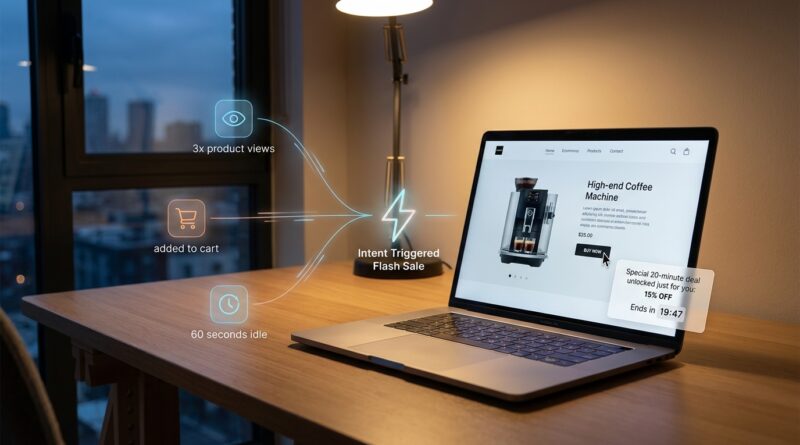
The ‘Intent-Triggered Flash Sale’ Strategy: Drop Custom Prices Only When Shoppers Show They’re Ready To Buy
You can feel it when a flash sale falls flat. You send the email, add the homepage banner, maybe even post the countdown on social, and still the lift is weak. Even worse, the buyers who do convert are often the people who were already halfway to checkout. You did not create new demand. You just gave away margin. That is why the intent based flash sale strategy is worth your attention. Instead of showing discounts to everyone, you wait until shoppers do something that signals real buying intent. Maybe they visit the same product twice, spend a few minutes on a high-ticket page, start checkout, or add an item to cart and hesitate. Then, and only then, you show a short-lived offer. It feels more relevant to the shopper, and it protects your pricing from becoming background noise. For smaller ecommerce brands, this is one of the simplest ways to start using smarter pricing without buying some giant enterprise system.
⚡ In a Hurry? Key Takeaways
- An intent based flash sale strategy only shows a limited-time deal after a shopper shows clear signs they are close to buying.
- Start with 2 or 3 simple triggers, like repeat product views, cart abandonment, or checkout hesitation, then test a small discount or bonus.
- This approach can cut discount waste, but you should cap how often a shopper sees offers so you do not train people to wait for a lower price.
Why broad flash sales disappoint
Blanket flash sales sound exciting in the meeting room. In practice, they often do three unhelpful things at once.
First, they teach your regular customers to hold off because another discount is probably coming soon.
Second, they lower the value of your products in the shopper’s mind. If there is always a sale, the full price starts to look fake.
Third, they waste money on people who never needed a push in the first place.
That is the basic problem the intent based flash sale strategy tries to fix. It is not about being sneaky. It is about being selective.
What an intent-triggered flash sale actually is
Think of it like a good store associate. They do not walk up to every person who enters and instantly offer 20 percent off. They wait. They watch for signs. Is the shopper comparing options? Returning to the same shelf? Holding the item and lingering?
Your website can do a lighter version of that.
An intent-triggered flash sale is a discount, bonus, or perk that appears only after a shopper takes an action that suggests they are close to purchasing. The trigger matters more than the discount size.
Common high-intent signals
These are the kinds of actions that usually mean a shopper is serious:
- Viewing the same product page more than once in a short period
- Spending 60 seconds or more on a product page
- Adding an item to cart but not checking out
- Starting checkout and pausing
- Coming back from an abandoned cart email
- Scrolling deep into reviews, shipping, or return policy details
Those are not random clicks. They are buying signals.
Why this works better than a site-wide sale
People are tired of generic offers. By 2026, shoppers have seen every countdown timer, every “today only” popup, every fake urgency trick. Most of it blends together.
A trigger-based offer feels different because it shows up in a moment that makes sense. The shopper is already engaged. They are doing the mental math. A small nudge at that point can help them finish the purchase.
It also protects your margins because fewer people see the offer. You are not putting your entire catalog on sale just to catch a handful of hesitant buyers.
How to build an intent based flash sale strategy without fancy tools
This is the part smaller brands usually overcomplicate. You do not need a huge personalization platform to get started. Basic analytics, popup tools, email flows, and cart rules can go a long way.
Step 1: Pick one friction point
Start where shoppers seem to stall. If your cart abandonment rate is high, begin there. If people browse expensive products but rarely convert, use product-page behavior as your trigger.
Do not try to build five trigger systems at once.
Step 2: Choose one clear trigger
Good examples include:
- Added to cart, no checkout within 10 minutes
- Visited a product page twice in 48 hours
- Reached checkout, then showed exit intent
Keep it simple enough that you can measure it.
Step 3: Decide on the offer
This is where brands often go straight to a price cut. Sometimes that is right. Sometimes it is not.
You could offer:
- 5 to 10 percent off
- Free shipping
- A free gift
- Bonus loyalty points
- A bundle upgrade
For many brands, a non-discount perk protects margin better than another percentage-off coupon.
Step 4: Set a real time limit
If the offer is called a flash sale, it needs a short window. Think 15 minutes, 1 hour, or until midnight. Long enough to act. Short enough to feel tied to that moment of intent.
Just make sure the timer is honest. Fake scarcity ruins trust fast.
Step 5: Limit frequency
If the same shopper gets an offer every time they pause, they will learn to pause on purpose. Set rules so each person only sees one trigger offer every so often.
This is the safety rail that keeps a smart tactic from turning into constant discounting.
Examples that make sense in the real world
Example 1: The hesitant apparel shopper
A shopper visits the same $120 jacket twice in three days, checks the size guide, and adds it to cart but does not buy. A popup appears offering free shipping for the next 30 minutes. That may be enough to remove the last bit of hesitation without cutting the jacket price.
Example 2: The high-consideration beauty buyer
A shopper spends several minutes reading ingredient details and reviews for a skincare set, then leaves. An email sent two hours later offers a free deluxe sample if they complete the order by the end of the day. The brand protects price while still giving the shopper a reason to return.
Example 3: The checkout pause
A customer enters checkout for a premium kitchen tool, then stalls on shipping costs. The site shows a one-time free shipping offer valid for the next 20 minutes. That is far better than running a store-wide 15 percent off campaign all weekend.
Where brands get this wrong
There are a few easy mistakes to avoid.
Showing the offer too early
If someone lands on a page and instantly gets a discount, that is not intent-triggered. That is just a popup with better branding.
Making the trigger too broad
If every product view counts as “high intent,” you are back to discounting everyone. Use signals that actually suggest buying behavior.
Using discounts when a bonus would do
Sometimes the buyer does not need a lower price. They need reassurance, convenience, or a little extra value.
Ignoring long-term behavior
If a customer repeatedly gets rewarded for waiting, you are training them. Watch repeat sessions and suppress offers when needed.
How this fits with other smarter sale tactics
Intent is one useful signal, but it is not the only one. Location, timing, traffic source, and customer segment can also help you be more precise.
For example, if you want to narrow offers by where buyers are most likely to convert, take a look at The ‘Geo‑Trigger Flash Sale’ Strategy: Drop Instant Deals Only Where Your Best Buyers Actually Stand. It follows the same basic idea. Stop shouting the same offer at everyone, and start putting it where it has the best chance to work.
What to measure so you know it is working
You do not need a giant dashboard. Track a few numbers that tell the real story:
- Conversion rate of shoppers who saw the triggered offer
- Average order value
- Margin impact compared with your normal sale campaigns
- How many conversions came from bonuses versus direct discounts
- Repeat purchase rate after the offer
The key question is not just, “Did more people buy?” It is, “Did more of the right people buy without forcing us to discount the entire store?”
Best first test for a small ecommerce brand
If you want a low-risk starting point, try this:
- Trigger: item added to cart, no checkout after 15 minutes
- Offer: free shipping or 10 percent off
- Time limit: 30 minutes
- Frequency cap: once per shopper every 14 days
That one test can teach you a lot. If it works, move to a second trigger. If it does not, adjust the offer before you expand.
At a Glance: Comparison
| Feature/Aspect | Details | Verdict |
|---|---|---|
| Blanket flash sale | Shown to everyone through emails, banners, and site-wide codes, including shoppers who would have paid full price. | Easy to run, but often wastes margin and causes discount fatigue. |
| Intent-triggered flash sale | Offer appears only after signals like repeat product views, cart hesitation, or checkout pauses. | Best balance of relevance, conversion lift, and pricing control for most smaller brands. |
| Bonus-based trigger offer | Uses free shipping, gifts, or loyalty points instead of cutting the product price. | Often the smartest first test if you want to protect margins. |
Conclusion
Dynamic and personalized pricing can sound like something only giant retailers can afford. It is not. The intent based flash sale strategy is a practical middle ground. You watch for a few high-intent actions, then show a limited-time offer only when it makes sense. That means fewer pointless discounts, less money left on the table, and a sales approach that feels helpful instead of desperate. For smaller brands, this is doable right now with basic analytics, popup tools, email flows, or cart rules. And it fits the way people shop in 2026, where attention is thin and generic “20% off everything” messages barely register. Start small, test one trigger, and treat every offer like a scalpel, not a megaphone.