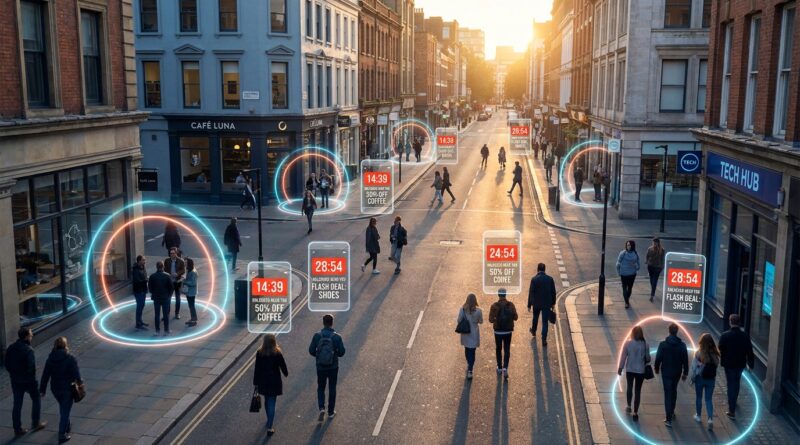
The ‘Geo‑Trigger Flash Sale’ Strategy: Drop Instant Deals Only Where Your Best Buyers Actually Stand
You can feel the waste in a generic flash sale. You blast an email, post on social, maybe run a paid ad, and then hope the right people happen to notice before the timer runs out. Most do not. Worse, your best customers might be walking past your store, standing inside a partner retailer, or browsing near a competitor, phone in hand, ready to buy something today. They just are not getting a reason to choose you right now. That is why the geofencing flash sale strategy for ecommerce is getting so much attention. It is not about shouting louder. It is about being more relevant. Instead of offering 20 percent off to everybody, you drop a tight, time-sensitive deal only to people in a specific place. Done well, this can raise conversions, cut ad waste, and help you avoid the habit of running another boring sitewide sale that teaches shoppers to wait for discounts.
⚡ In a Hurry? Key Takeaways
- A geofencing flash sale strategy for ecommerce sends limited-time offers to shoppers based on where they are, not just who is on your email list.
- Start small. Test one city, one store, or one competitor location with a simple offer and a short redemption window.
- Keep privacy and customer trust front and center. Use opt-in channels, clear messaging, and avoid creepy wording about exact location.
Why this works better than another sitewide sale
Most flash sales fail for a simple reason. Timing and context are off.
A shopper at home on the couch is one kind of customer. A shopper standing two blocks from your store is another. Someone inside a mall where your product is stocked is another. And a customer lingering near a competitor is a very different kind of buyer again. Their intent is hotter. Their attention is local. Their decision window is short.
That is what makes this approach useful. You are matching the offer to the moment.
Instead of saying, “Hey everyone, 25 percent off today,” you say, “You are nearby. Here is a reason to act in the next hour.” That is more relevant, and relevance usually beats volume.
What a geofencing flash sale strategy for ecommerce actually is
Geofencing sounds technical, but the idea is simple. You draw a virtual boundary around a real-world place. When a shopper with an opted-in app, ad platform signal, SMS program, or push notification setting enters that area, they become eligible to see a specific offer.
Common places to set a geofence
Here are the easiest starting points:
- Your own store or pop-up location
- A stockist or retail partner that carries your products
- A mall, event venue, or busy shopping district
- A competitor storefront
- A neighborhood where past buyers cluster
The offer then appears through one of a few channels. Usually mobile ads, app push notifications, SMS, or email follow-up triggered by location data from your ad stack or customer platform.
The real pain point this fixes
If you run ecommerce, you already know the trap. You spend money getting traffic. You run a sale. A chunk of your list ignores it. Another chunk buys only when you discount heavily. Meanwhile, people with strong buying intent slip by because your promotion has no connection to what they are doing in real life.
Geofenced flash sales fix that by narrowing the audience and tightening the moment. That means:
- Less wasted ad spend
- Higher odds of immediate action
- Better use of local demand
- Less pressure to discount your whole catalog
That last point matters. A lot. Endless broad sales can quietly train customers to never pay full price.
How to set one up without turning it into a giant project
You do not need a huge team for this. In fact, the smartest first test is usually boring on purpose. Keep it small and measurable.
1. Pick one location that already has buying intent
Do not start with fifty fences across three states. Pick one. Maybe your highest-performing store. Maybe one retail partner. Maybe one competitor that gets the kind of foot traffic you want.
Your goal is not scale on day one. Your goal is proof.
2. Match the offer to the location
This is where many brands get lazy. If someone is near your store, offer something that makes sense in that moment:
- 15 percent off for pickup today
- Free gift with purchase in the next 2 hours
- Exclusive bundle available only nearby
- Same-day local delivery discount
If someone is near a competitor, your message should be about switching, not generic savings. Think “Compare before you buy. Save $20 today.” Short. Clear. Timely.
3. Keep the time window tight
A flash sale should feel immediate. One to four hours often works better than “today only,” because it creates a real reason to move now.
Short windows also help you measure whether location was the trigger, not just the discount.
4. Use one clean call to action
Do not make people decode your campaign. Tell them exactly what to do:
- Show this code in store
- Tap to buy for pickup
- Claim offer before 4 PM
If redemption is clunky, performance will suffer. Fast.
5. Track store-level and campaign-level results
At minimum, measure:
- Impressions in the geofenced area
- Click-through or open rate
- Redemption rate
- Revenue per offer sent
- Lift versus a similar non-geofenced audience
You want to know whether the location itself improved performance, not just whether discounts get clicks.
Three smart use cases small brands can test this week
Near your own store
This is the easiest starting point. If someone is close by, give them a reason to stop in or order for pickup. This works especially well for beauty, food, apparel, and any product where instant gratification matters.
Near a retail partner
If your products are sold through stockists, use geofenced offers to push people into those locations. It is a practical way to support sell-through without cutting price across your entire online store.
Near a competitor
This is the bold one. It can work very well if your product has a clear advantage, like better ingredients, better pricing, or faster fulfillment. Just keep the tone smart. Do not sound desperate. Give people a reason to compare and act.
What to avoid, because this can get creepy fast
Location-based marketing works best when it feels helpful, not invasive.
Do not overstate how much you know
Never write copy that feels like surveillance. “We saw you outside the mall” is a terrible message. “Nearby shoppers get 15 percent off for the next hour” says the same thing without making anyone uneasy.
Do not use too many alerts
If every visit to a shopping district triggers a deal from you, people will tune out or opt out. Save this for moments that matter.
Do not make the discount your whole strategy
The point is smarter timing, not constant markdowns. The best campaigns use location as the edge, not just price.
Tools and channels that usually power this
You do not need to build a custom app from scratch. Many brands run geofenced campaigns through:
- Meta and Google location-based ad targeting
- Mobile ad platforms with geofencing support
- SMS platforms connected to customer segments and local triggers
- Loyalty or brand apps with push notification opt-ins
- Retail media or partner-store ad programs
If you are a smaller ecommerce brand, paid social or mobile display with tight local targeting is often the simplest place to start. If you already have a strong SMS list or app audience, even better.
How to write the offer so it does not sound like ad sludge
Keep it human. Keep it direct. A few examples:
- Close by? Grab 15% off for pickup in the next 2 hours.
- Shopping nearby. Get a free mini with any order before 5 PM.
- Before you buy there, compare us. Save $20 today only.
Notice what is missing. No buzzwords. No weird hype. No giant paragraph. Just place, value, urgency.
How to know if it is actually working
The easiest mistake is celebrating clicks. Clicks are nice. Sales are nicer.
What you really want to see is whether geofenced traffic converts better than your usual sale traffic, and whether the cost per purchase drops. If it does, you have a repeatable play. If it does not, check three things first:
- Was the geofence placed where true intent exists?
- Was the offer strong enough for that moment?
- Was the redemption process easy?
Most failed tests break on one of those three points.
At a Glance: Comparison
| Feature/Aspect | Details | Verdict |
|---|---|---|
| Audience targeting | Geofenced flash sales reach shoppers in a specific physical area at a specific time, instead of sending the same offer to your full list. | Much more relevant than a broad blast |
| Speed to test | You can test one city, one store, or one competitor location with a short offer window and basic tracking. | Low-lift and fast to validate |
| Risk and trust | Location-based messaging can feel useful or creepy depending on wording, frequency, and whether shoppers have clearly opted in. | Worth doing, but handle with care |
Conclusion
If your current sales strategy feels like shouting into the void, this is a smarter next test. Geofenced flash sales are having a moment because attention and intent are getting hyper local again. Retailers and DTC brands are using location data to nudge real-world behavior in real time, not just chase clicks. That makes this useful for The Deal community right now because it is practical, relatively light to set up, and built to turn cold traffic into hotter buyers by tying the offer to where a shopper is standing at that moment. The upside is simple. Better conversion, less wasted spend, and a more interesting play than another generic sitewide discount. Start with one city, one partner store, or one competitor location. Keep the offer clear. Keep the time window short. Then watch what happens over a few days, not a few months.