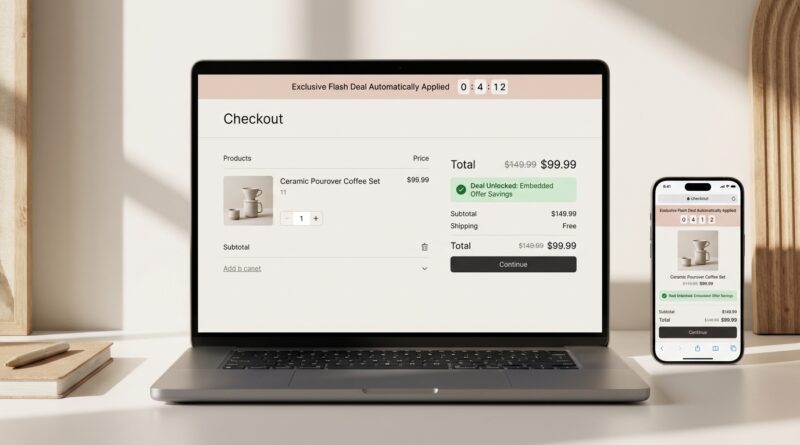
The ‘Embedded Offer Checkout’ Flash Sale: Turn Invisible Discounts Into Instant Conversions
Flash sales should feel exciting. Too often, they feel like homework. A shopper sees your ad, clicks through, likes the product, then gets stuck hunting for a code, wondering if the banner still applies, or forgetting the deal exists by the time they reach checkout. That is frustrating for them, and expensive for you. A lot of brands are not losing sales because the offer is weak. They are losing sales because the discount is hidden, scattered, or easy to miss. That is why the embedded offer checkout flash sale strategy matters right now. Instead of asking people to remember a code or decode your promo rules, the discount appears automatically when they qualify. Add the right item. Hit the cart total. Shop during the time window. Done. It feels simple because it is simple. And when checkout does the work, more shoppers actually finish the purchase.
⚡ In a Hurry? Key Takeaways
- Embedded offers work best when the discount applies automatically at checkout instead of relying on coupon codes.
- Start with one clear trigger, like a cart threshold or limited-time product bundle, then show the savings instantly.
- This approach cuts confusion and abandoned carts, but only if the rules are easy to understand and the checkout message is crystal clear.
Why Flash Sales So Often Fall Flat
Most shoppers do not wake up hoping to solve a discount puzzle.
They want to know two things. What does this cost me, and what do I need to do next? If your flash sale depends on an email they did not open, a homepage banner they did not notice, or a promo box buried at the very end, you are asking them to carry too much mental load.
That is where good intentions go bad. Marketing launches a sale. Paid ads talk about urgency. Email pushes a code. Social mentions a different version of the deal. Then checkout shows full price until the customer figures out the trick. That gap is where conversions disappear.
The embedded offer checkout flash sale strategy fixes that by moving the offer closer to the moment of purchase. Not louder. Closer.
What “Embedded Offer Checkout” Actually Means
Let’s strip the jargon out of it.
An embedded offer is simply a discount that unlocks automatically inside the shopping flow. The shopper does not need to type a code, search their inbox, or guess if the sale still applies. The system checks the rules and applies the savings when the customer qualifies.
Common ways it can trigger
Here are the usual setups:
- Buy a specific product and get an instant discount
- Spend over a set amount and save automatically
- Shop during a short time window and see the price drop in cart
- Add a bundle and get a built-in flash deal
- Unlock free shipping or a gift when the cart meets the requirement
The customer experience is the key part. They should feel like the store is handling the offer for them. Not making them earn it through detective work.
Why This Works Better Than the Usual Coupon Code Routine
Coupon codes sound simple on paper. In real life, they create friction.
People mistype them. They forget them. They leave the site to search for a better one. They wonder if they are missing out on some secret deal. The second that thought enters their head, checkout is no longer a straight line.
Embedded offers remove that pause.
That matters during a flash sale because urgency has a short shelf life. If the shopper is ready now, you need the path to purchase to stay smooth now. Not after they check their inbox. Not after they scroll back up to read the banner again.
What shoppers feel
A good embedded offer creates a small moment of relief. The shopper adds an item, sees “Discount applied,” and gets a little win. That feeling is stronger than another flashing countdown clock.
It says, “You qualified. We took care of it.”
How to Build an Embedded Offer Checkout Flash Sale Strategy
You do not need to rebuild your whole store to start. You do need a cleaner plan.
1. Pick one behavior you want to drive
Do you want shoppers to:
- Buy a specific high-margin item?
- Increase average order value?
- Clear seasonal inventory fast?
- Convert first-time visitors before they leave?
Choose one main goal. If one sale tries to do five jobs, the message gets muddy.
2. Use a trigger shoppers can understand instantly
The best offers are easy to explain in one short sentence:
- Add 2 items, save 20%
- Spend $75, get $15 off
- Tonight only, discount auto-applies at checkout
If your promo needs an asterisk, a footnote, and a flowchart, it is too complicated.
3. Show progress before checkout, not just at checkout
Automatic should not mean invisible.
Shoppers still need reassurance that the deal is real. Good stores show messages like:
- You are $12 away from unlocking your flash discount
- Flash offer active. Add one more item to save 25%
- Discount applied automatically
This is the sweet spot. No code entry, but plenty of clarity.
4. Keep the discount visible in cart and checkout
Nothing kills trust faster than a deal that seems to disappear.
Once the offer is triggered, the cart and checkout should clearly show:
- What discount was applied
- Why it was applied
- How much the shopper saved
That confirmation helps close the sale. It also cuts support questions later.
5. Match the sale window to buying behavior
Not every flash sale needs to last four hours. Not every one should last three days either.
If your audience shops heavily at lunch, test a midday auto-offer. If they convert after work, try an evening checkout deal. The point is not fake urgency. The point is well-timed urgency.
Three Smart Use Cases
Cart threshold sale
This is the easiest place to start. For example, “Spend $60, save $10 automatically.” It pushes average order value up without making shoppers mess with codes.
Product-specific flash push
Need to move a certain category fast? Set the offer to trigger when that item is added. This works well for accessories, beauty bundles, and seasonal products.
Timed checkout surprise
Instead of shouting “Use code FLASH20,” you can run a short window where the savings simply appear. This feels cleaner and often converts better because there is less friction between interest and purchase.
What to Watch Out For
Automatic offers are not magic. They still need care.
Too many overlapping promos
If shoppers can trigger three discounts, stack a coupon, and still see a sitewide banner, the experience gets messy fast. Pick a hierarchy and stick to it.
Vague messaging
“Special savings may apply” is not helpful. Be direct. Tell shoppers what to do and what they get.
Checkout systems that hide the savings
If your platform technically applies the deal but does not show it clearly, shoppers may assume it failed. Visibility matters as much as the math.
Margins that do not survive success
Run the numbers before launch. Embedded offers can increase conversion nicely, but you still need to protect profit. Test on a limited segment or product line first if needed.
How to Measure If It Is Working
Do not judge this strategy by raw traffic or email opens alone.
Watch the numbers closest to the buying decision:
- Cart-to-checkout rate
- Checkout completion rate
- Average order value
- Discount redemption rate
- Revenue per visitor
- Support tickets about missing promos
The real test is simple. Are more people finishing the sale with less confusion?
If the answer is yes, you are on the right track.
How to Talk About It in Your Marketing
This may be the easiest win of all.
Once your offer is embedded properly, your message gets shorter and stronger:
- Just add it to cart, we’ll do the rest
- No code needed
- Your flash discount applies automatically
- Shop now, savings unlock at checkout
That is cleaner than explaining coupon steps in every ad, email, and social post. It also reduces the fear that shoppers are missing something important.
At a Glance: Comparison
| Feature/Aspect | Details | Verdict |
|---|---|---|
| Coupon-code flash sale | Customer must notice the promo, remember the code, and enter it correctly at checkout. | Works, but creates friction and lost redemptions. |
| Embedded offer checkout | Discount triggers automatically when the shopper meets clear rules like product, cart value, or time window. | Best for smoother checkout and higher conversion potential. |
| Customer trust and clarity | Visible savings in cart reduce confusion and reassure shoppers the deal is real. | A major advantage if your current promos feel scattered. |
Conclusion
There is a big gap right now between the discounts brands create and the discounts shoppers actually use. That is the opening. New data around embedded offers points to a simple truth: people are overwhelmed by codes, banners, and promo clutter, and many of those deals never shape the final click. A smart embedded offer checkout flash sale strategy flips that around. Instead of yelling louder, you make the savings appear at the exact moment they matter. The shopper adds the right product, hits the cart threshold, or lands during the right time window, and checkout handles the rest. That means fewer abandoned carts, less second-guessing, and a much cleaner message for your audience: just add it to cart, we’ll do the rest. While other brands keep piling on more noise, you can turn checkout into the quiet closer that helps more people actually buy.