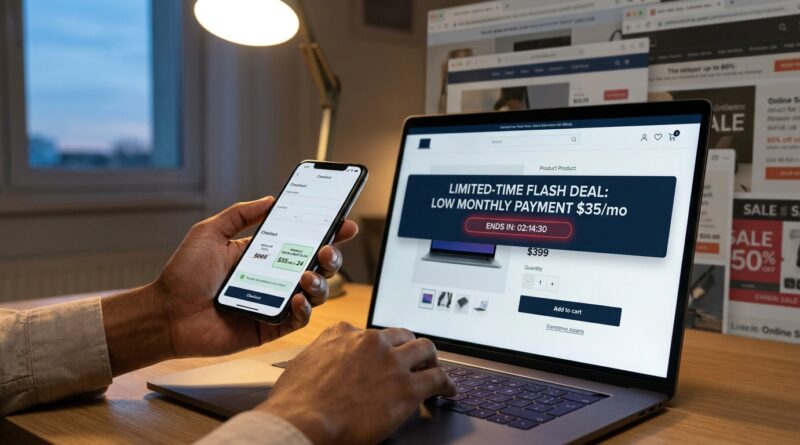
The ‘Financed Flash’ Sale Strategy: Turn Buy-Now-Pay-Later Into Your Secret Conversion Weapon
Shoppers are tired, and honestly, who can blame them. Every store seems to run the same flash sale. A red countdown clock. A 20% off badge. Three emails in one day. Then the customer gets to checkout, sees the full total, and backs out. That is the real problem. It is not that your discount is too small. It is that the price still feels too heavy in one hit.
That is why a smart ecommerce flash sale payment plan strategy can work better than another basic markdown. When you pair a real limited-time deal with clear buy-now-pay-later terms, you shift the question in the shopper’s mind from “Is this cheaper?” to “Can I afford this today?” In 2026, that second question is often the one that decides the sale. If you run online promos, this is your opening. Do not just cut the price. Reframe the payment.
⚡ In a Hurry? Key Takeaways
- Flash sales convert better when you promote monthly affordability, not just the discounted total.
- Show installment terms early on product and sale pages, not only at checkout.
- Use payment plans carefully. Clear terms and realistic inventory protect trust and reduce buyer regret.
Why ordinary flash sales are losing their punch
Most flash sales blend together now. Same colors. Same timer. Same “today only” promise that somehow comes back next week.
Shoppers have learned to tune that out. They are also under more pressure. Groceries cost more. Bills cost more. So even when people want the item, the full checkout amount can still feel like a brick wall.
That is why many stores are seeing traffic without enough completed orders. The interest is there. The affordability is not.
The real shift: from discount-first to payment-first
A strong ecommerce flash sale payment plan strategy starts with one simple idea. People do not buy based only on the sale price. They buy based on whether the payment fits into this week’s budget.
Say a gadget drops from $600 to $499. That sounds nice. But “4 payments of $124.75” often feels much more doable than “Pay $499 now.” Same product. Same discount. Very different emotional reaction.
This does not mean the discount stops mattering. It means the payment framing becomes the conversion tool.
What shoppers are really asking
When someone lands on your flash sale page, they are often asking three quiet questions:
- Is this a real deal?
- Can I manage the payment right now?
- Will I regret this later?
Your job is to answer all three, fast.
How to build a financed flash sale that actually converts
1. Put the installment message next to the sale price
Do not hide BNPL until the last checkout screen. That is too late.
If your sale banner says “Flash Deal: $499 today only,” the line right under it should say something like “Or 4 interest-free payments of $124.75.” This gives shoppers an instant mental shortcut.
It also reduces the sticker shock that kills carts.
2. Make the deal feel genuinely better than normal financing
A financed flash sale should not just be your standard payment option with a timer slapped on it.
Give shoppers a reason to act now. For example:
- Longer interest-free terms during the sale window
- Lower first payment today
- No down payment for qualifying buyers
- Bonus bundle only when using the sale payment plan
This is where the “flash” part earns its keep. The offer needs to feel meaningfully different.
3. Be painfully clear about the terms
Nothing destroys trust faster than a nice-looking monthly number followed by surprise fees.
Spell out:
- How many payments there are
- Whether interest applies
- Whether approval is required
- What happens with late payments
If the terms are fair, say so plainly. If they are complicated, simplify the language. Good conversion is built on confidence, not confusion.
4. Use financed flash deals on the right products
This works best on items people want but may hesitate to pay in full for right away. Think furniture, laptops, phones, home appliances, fitness gear, premium beauty tech, and bigger fashion carts.
It is less useful on very low-cost impulse items. Nobody needs a complicated installment plan for a $14 accessory.
Where stores often get this wrong
Some brands get excited about payment plans and forget the basics. That is when problems start.
The discount is fake
If the “sale” price is the same number customers saw two weeks ago, they will notice. Or they will feel it, even if they cannot prove it. Either way, trust takes a hit.
The monthly price is shown, but the total is buried
That feels sneaky. Show both. The total sale price and the installment amount should sit together.
The stock is not ready for the rush
A financed flash sale can lift conversion fast. That is great, unless you sell units you cannot ship. If you are planning a big campaign across channels, it is worth reading The ‘No‑Oversell Flash Sale’ Play: How To Run All‑Channel Deals Without Breaking Your Stock (Or Your Reputation). It covers the mess that happens when demand beats inventory.
What this looks like in the real world
Let’s keep it simple.
Store A runs a flash sale on a $1,200 sofa. It is now $999 for 24 hours. Nice enough. But the page mostly screams “17% OFF” and “Ends Tonight.”
Store B runs the same style of sale, but the message is different. “Today only: $999 or 12 interest-free payments of $83.25.” The page also explains delivery timing, return policy, and total cost in plain English.
Which one feels easier to say yes to? For most shoppers, it is Store B. Not because the sofa is better. Because the purchase feels possible.
Tips for making the strategy feel helpful, not pushy
Lead with affordability, not pressure
Use phrases that reduce friction. “Spread out the cost.” “Pay over time.” “Interest-free for qualified shoppers.”
Skip the aggressive stuff. People are already stressed. They do not need more shouting.
Match the payment plan to the campaign
If the sale lasts 48 hours, the financing bonus should be just as clear. Maybe longer terms are available only during that window. Maybe the first payment is delayed until next month.
Keep it tidy. One sale. One clear payment hook.
Train your team and support channels
If shoppers ask questions in chat, email, or social comments, they should get straight answers. Confusion during a flash sale kills momentum.
Prepare short replies for common concerns like approvals, fees, returns, and what happens if an item is out of stock.
Why this matters even more in 2026
Big shopping events around the world have taught people to wait for sales. That part is not going away. But endless sitewide promos have also made shoppers numb.
A plain discount does not always move the needle now. Affordability does.
That is the key difference. If your sale helps someone fit a wanted purchase into real life, it stands out. If it is just another percentage-off graphic, it gets ignored.
At a Glance: Comparison
| Feature/Aspect | Details | Verdict |
|---|---|---|
| Traditional flash sale | Focuses on percent off, urgency, and countdown timers, but still asks for the full payment at checkout. | Good for attention. Often weak for higher-ticket conversion. |
| Financed flash sale | Combines a real discount with clear buy-now-pay-later terms shown early in the shopping journey. | Best choice when shoppers want the item but need breathing room on cash flow. |
| Trust and execution | Works only if pricing is honest, terms are easy to understand, and stock can support the promo. | Essential. Poor execution can hurt both sales and reputation. |
Conclusion
The smartest flash sales now do more than shave a few dollars off the top. They make the purchase feel manageable. Hot Sale events and giant campaign days are teaching people to wait for discounts, yes, but most buyers still decide based on whether they can actually afford the item today, not just how dramatic the price slash looks. That is why spotlighting flash deals with real savings and unusually generous installment terms can do so much more for your audience and your store. You help people buy what they truly want without blowing up their cash flow, and in 2026, that matters a lot more than another noisy “sitewide” sale banner.