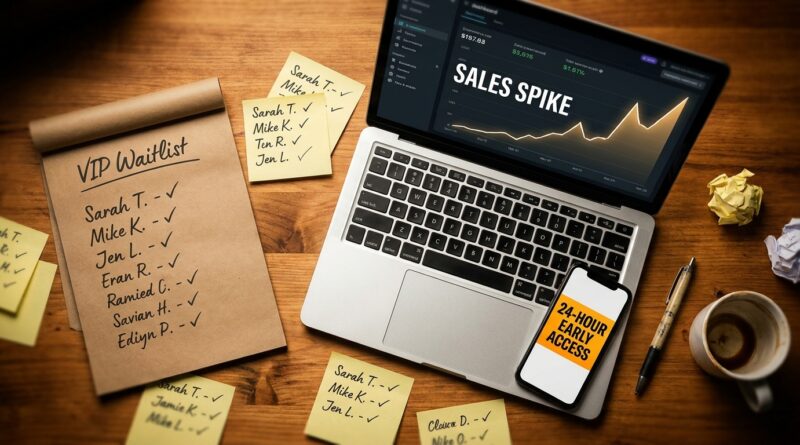
The ‘Waitlist Surge Flash’ Strategy: Turn One VIP Queue Into Your Highest‑Intent 24‑Hour Sale
You know the pattern. You set up a flash sale, send the emails, maybe throw in a bigger discount than you wanted, and watch a burst of clicks turn into a pretty average sales day. It is frustrating because the traffic looks exciting, but the profit often does not. Worse, every rushed promo teaches your list to wait for the next markdown. That is where an ecommerce waitlist flash sale strategy can change the game. Instead of shouting a deal at everyone all at once, you build a small VIP queue first. People raise their hand before the sale even opens. Then you give that group a tight 24-hour buying window with one clear offer and a reason to act now. The result is usually better intent, cleaner email engagement, and a sale that feels more like an event than a clearance rack.
⚡ In a Hurry? Key Takeaways
- A VIP waitlist flash works best when you collect interest before the sale, then open a 24-hour offer only to people who joined.
- Use one product theme, one promise, and a short warm-up sequence so buyers know exactly why they should join and buy.
- This approach protects margin better than constant storewide discounts because you are selling to high-intent shoppers, not training everyone to ignore full price.
Why regular flash sales so often disappoint
Most flash sales fail long before launch day. The problem is not always the product or the price. It is timing and audience quality.
When you blast an offer to your whole list, you get three groups. People who were never interested. People who are mildly curious but not ready. And bargain hunters who only show up for discounts. That mix can create noise without giving you many strong buyers.
A waitlist changes that mix. It asks customers to make a tiny commitment first. Not a purchase. Just a hand raise. That one step matters more than people think.
What the Waitlist Surge Flash strategy actually is
The idea is simple. You invite shoppers to join a VIP waitlist for a specific drop, bundle, or limited deal. You spend a few days warming them up. Then you open the sale for 24 hours.
You are not trying to create fake hype. You are trying to identify real demand before you put pressure on margin, inventory, and deliverability.
The three parts that make it work
1. A clear reason to join. This could be early access, a bonus gift, locked pricing, limited stock, or a bundle only available during the flash.
2. A short warm-up period. Usually three to seven days is enough. During that time, you remind people what is coming and why it matters.
3. A strict buying window. Twenty-four hours is long enough for busy people to act, but short enough to create real urgency.
Why this works better than a random discount blast
An ecommerce waitlist flash sale strategy works because it rewards intent, not just attention.
If someone joins your waitlist, they are telling you something useful. They care about that category, that problem, or that product angle. Now your sale is aimed at people who already want in.
That gives you a few advantages.
Better conversions
You are speaking to shoppers who opted in for this exact offer. They are warmer than your average subscriber.
Better margins
You do not need a giant discount to wake people up. The exclusivity and limited window do some of the heavy lifting.
Better email performance
Sending the main push to a more engaged segment usually helps open rates, clicks, and inbox placement. That matters if your regular promo calendar is already noisy.
Better planning
If 800 people join the waitlist and only 50 usually buy, that is one story. If 800 join and 300 are clicking every teaser, that is a different one. You get a read on demand before launch.
How to set one up without making it complicated
You do not need a huge tech stack for this. A landing page, your email tool, and a simple segmentation rule are enough for most stores.
Step 1: Pick one focused offer
Do not make the VIP waitlist about your entire catalog. That gets fuzzy fast. Pick one hero product, one bundle, one category drop, or one limited restock.
The more specific the promise, the better the sign-up quality.
Good examples:
- VIP access to our summer travel bundle
- 24-hour first shot at the limited candle restock
- Members-only pricing on our best-selling skincare set
Step 2: Build a simple waitlist page
Your page should answer three questions in seconds.
- What is the offer?
- Why should I join?
- When does it open?
Keep the form short. Usually email is enough. If SMS is important for your brand, offer it as optional rather than mandatory.
Step 3: Send a short warm-up sequence
This is where many stores get lazy. They collect sign-ups and then go quiet. That is a mistake.
Warm-up emails should be brief and useful:
- Confirmation email: “You’re on the list”
- Problem or benefit email: why this drop matters
- Proof email: reviews, results, or customer favorite status
- Reminder email: sale opens tomorrow
- Launch email: VIP access starts now
- Final reminder: a few hours left
Step 4: Open the 24-hour window and keep it clean
Do not muddy the message with five discount codes and side offers. One page. One timer. One reason to buy now.
If your store already uses short, intense sale windows around major shopping moments, you may also like The ‘Prime Shadow Flash’ Strategy: Turn Big-Box Sale Days Into Your Highest-Margin 3-Hour Spike. It is a good companion idea when you want to stack your own timing against larger retail events.
What to say in your messaging
The best waitlist campaigns sound confident and specific. Not desperate.
Avoid writing like a clearance sign. Instead, talk like you are inviting insiders into something limited and worthwhile.
Examples of stronger angles
- Join the VIP list for first access before the public release.
- This bundle is available for 24 hours only, then it is gone.
- Waitlist members get the launch price and bonus gift.
- We are opening a limited restock to the list first tomorrow at noon.
You are not begging for attention. You are setting expectations.
Common mistakes that can ruin the whole thing
Making the offer too broad
If everything is included, nothing feels special. A focused flash almost always beats a vague storewide event.
Leaving the wait too long
If people join and then hear nothing for two weeks, the energy dies. Keep the gap short.
Using a weak reward for joining
“Be the first to know” is fine, but “be the first to buy” is better. Add something tangible if you can.
Extending the deadline
If the 24-hour sale becomes a 48-hour sale because results looked soft, customers notice. Urgency only works when you mean it.
Discounting too hard
The point is not to slash prices until they hurt. The point is to concentrate demand from shoppers who already care.
Who should use this strategy first
This works especially well for smaller ecommerce brands that cannot afford endless broad promotions.
It is a smart fit if you sell:
- Limited inventory or handmade products
- Bundles with strong margins
- Seasonal drops
- Restocks with existing demand
- Products with a clear fan base
If your audience responds well to exclusivity, early access, and product storytelling, this is worth testing.
How to measure whether it worked
Do not judge it only by total revenue. Look at the quality of the sale.
Useful numbers to track
- Waitlist sign-up rate
- Open and click rates from the waitlist segment
- Conversion rate during the 24-hour window
- Average order value
- Gross margin compared with your usual flash sales
- Percentage of sales from the waitlist versus the general list
If a smaller segment brings in a bigger share of profitable orders, you are on the right path.
At a Glance: Comparison
| Feature/Aspect | Details | Verdict |
|---|---|---|
| Audience quality | Waitlist members have already shown interest before the sale begins, unlike a full-list blast that mixes loyal buyers with passive subscribers. | Strong win for conversions |
| Margin control | Because urgency comes from access and timing, not just price cuts, you can often use a better offer structure without going too deep on discounts. | Better for profit |
| Operational simplicity | You need a landing page, a segmented email flow, and a clear 24-hour launch plan. It takes planning, but it is repeatable once built. | Easy enough for small teams |
Conclusion
If your current flash sales feel loud but strangely flat, this is a better way to start. Right now everyone is chasing louder discounts and algorithm tricks while missing the simple win that is pre-sale intent. A tight, time-boxed VIP waitlist flash lets smaller stores pull off big-brand style launches without wrecking deliverability or margin. You validate demand ahead of time, concentrate orders into a single profitable window, and train customers to expect limited, high-value drops instead of permanent markdowns. For The Deal community, that is the real value. Your next flash sale does not have to be a last-minute scramble. It can become a repeatable system. Capture interest early, warm people up with one clear promise, then convert them in a 24-hour window where shoppers feel like insiders, not just email addresses on another discount list.