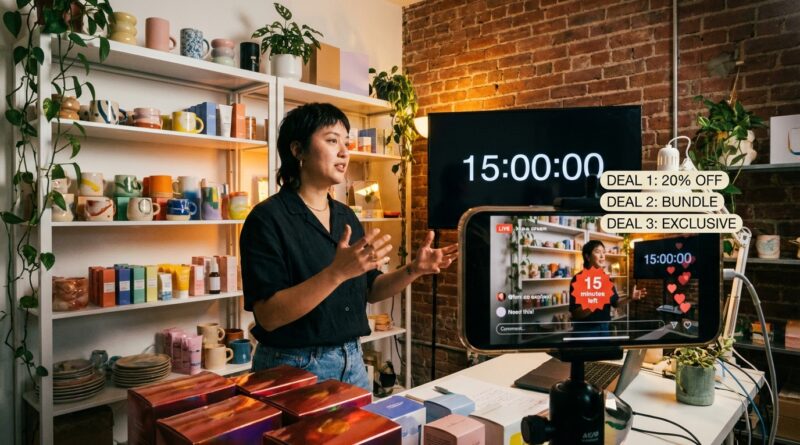
The Live-Stream Flash Sale: How To Turn One 45‑Minute Show Into Your Highest-Converting Drop
Going live and slapping on a discount sounds easy. Then the stream starts, a few people trickle in, nobody knows what is happening, the comments go quiet, and you are left wondering why the whole thing felt flat. That frustration is real. Most failed live sales are not failing because the product is bad. They fail because there is no plan, no pace, and no reason for viewers to buy now instead of later. A strong live shopping flash sale strategy fixes that. The goal is not to “be live” for 45 minutes. The goal is to guide people from curiosity to trust to checkout in one tight show. Done right, live commerce can convert 5 to 10 times better than a normal product page. Better yet, one event can also give you clips, customer questions, and proof points you can reuse for the rest of the week.
⚡ In a Hurry? Key Takeaways
- A 45-minute live sale works best when it follows a clear script: hook, demo, offer, urgency, Q&A, and final countdown.
- Use only 1 to 3 hero products, a visible deadline, and repeated calls to action so viewers always know what to do next.
- Do not rely on the platform alone. Warm up your audience before the event and save the best clips after the stream to stretch the value.
Why most live sales fall apart
The usual mistake is treating a live sale like a regular social post. Brand hits “go live,” talks casually about products, mentions a discount once or twice, then hopes the algorithm sends buyers.
That is not a sales event. That is a hanging-out session with a coupon attached.
People need structure. They need to know what is being sold, why it matters, how long the deal lasts, and what they should do right now. If those pieces are missing, viewers drift. They check a text. They open another app. They tell themselves they will come back later, and later never happens.
What a high-converting 45-minute show actually does
A good live show does three jobs at once. It entertains a little, answers objections in real time, and creates a deadline people can feel.
That mix is why live shopping works so well. Viewers are not staring at a cold product page alone. They are watching someone use the item, comparing options, asking questions in chat, and seeing other people react. That lowers hesitation fast.
The sweet spot is focus, not length
Forty-five minutes is enough time to build momentum without wearing people out. It is long enough for late joiners to catch the offer, but short enough to keep urgency high.
Try to feature one main product or a tight bundle, plus maybe one add-on. If you cram in ten SKUs, the stream turns into a messy catalog tour.
Your 45-minute live shopping flash sale strategy
Minute 0 to 5: Open with the reason to stay
Do not start with housekeeping. Start with the headline offer.
Say what the product is, who it is for, what makes tonight different, and exactly how long the deal lasts. Give viewers a reason to stick around for the next few minutes. For example: limited pricing, bonus gift, bundle upgrade, or stock cap.
Good opening beats “Hey guys, just waiting for more people to join.” Every second of dead air costs you sales.
Minute 5 to 15: Demo the hero product
Show the product solving a real problem. Keep it visual. Keep it simple. Do not read specs like a manual.
Instead of “This has a 4,000 mAh battery,” say “You can throw this in your bag in the morning and not think about charging it again until tonight.”
That is what non-technical buyers need. They want the real-life payoff.
Minute 15 to 25: Answer the objections before chat asks
This is where conversions jump. Cover the questions that stop people from buying.
- Will it fit?
- Is it hard to set up?
- How long does shipping take?
- What makes this better than the cheaper option?
- Who is this not right for?
That last one matters. Honest framing builds trust. If the product is best for a certain type of customer, say so.
Minute 25 to 35: Drop the strongest offer
Now put the deal in plain English.
Not “special savings available during the live.”
Try “For the next 20 minutes, this bundle is $39 instead of $54, and the first 50 orders get free shipping.”
Specific beats vague. Always.
If you want even better results, pair the live with a pre-event list. A private warm-up can do a lot of the heavy lifting before you even start. That is the idea behind The ‘VIP Warm‑Up’ Flash Sale: How Private Early Access Turns Your Next Drop Into A Guaranteed Sellout. The people most likely to buy should already know something good is coming.
Minute 35 to 42: Rapid-fire Q&A and proof
This is where chat becomes your sales team.
Answer questions quickly. Repeat the offer often. Share short customer quotes or reviews. If someone in chat says they ordered, acknowledge it. That social proof matters more than many brands realize.
People feel safer buying when they see other humans buying too.
Minute 42 to 45: Close hard, not awkwardly
Do not fade out. Count down.
Remind viewers what they get, when the price ends, and what happens after the timer runs out. Keep the final call to action simple. One link. One code if needed. One clear deadline.
Then end the live when you said you would. Scarcity only works if you mean it.
How to set up the sale so people actually show up
Promote the event like it matters
A live flash sale is not a surprise party. Tell people about it in advance.
Send email. Post countdown Stories. Pin a teaser video. Text your VIP customers. Put the date, time, and hook everywhere. Not just “we’re going live,” but “live at 7 PM, 45-minute only bundle, bonus for first 50 orders.”
Give viewers a reason to arrive on time
If the best deal is available from minute one, say that. If there is an early-bird bonus, make it clear. Viewers who join late are still valuable, but you want a core audience there right away so the chat feels alive.
Make checkout stupid simple
This is the part many brands overlook. If people need to hunt for the product page, type a long code, or guess which variant was mentioned, you will lose them.
Use a direct product link. Pin it. Repeat it verbally. Make sure the page matches what you are saying on screen. Same name, same price, same bundle.
Small production fixes that make a big difference
Sound matters more than camera quality
People will forgive average video. They will not forgive bad audio. Use a mic if you can. Record a quick test before you go live.
Use a host and a moderator if possible
One person talks. One person watches chat, drops links, flags good questions, and solves issues. This alone can make the stream feel twice as polished.
Keep your set clean and product-first
You do not need a studio. You need decent light, a quiet room, and a background that does not distract from the item you are selling.
What to say when you are not a natural on camera
You do not need to sound like an influencer. You need to sound clear and helpful.
Use this simple formula:
- Here is the problem.
- Here is how this product fixes it.
- Here is proof.
- Here is the deal.
- Here is why you need to act now.
That is enough. People respond to confidence and clarity more than polish.
After the stream, the job is not over
This is where smaller brands can punch above their weight. One well-run live event is not just a one-night sale. It is a content machine.
Clip the best moments
Cut up the strongest product demo, the best objection-handling answer, the moment the countdown starts, and any customer reactions from chat. Those short clips can become Reels, TikToks, paid ads, email embeds, and product page content.
Follow up with viewers and buyers
Send a “last chance” email right after the stream if the offer still has a short runway. Then send buyers a thank-you and non-buyers a recap with highlights.
Study the replay like game tape
Look for drop-off points. Which moments drove the most clicks? What questions kept coming up? Where did the energy dip?
Your second live should be tighter than your first. Your third should feel easy.
Common mistakes to avoid
- Talking too long before mentioning the offer
- Featuring too many products
- Using weak urgency that does not feel real
- Forgetting to repeat the link and deadline
- Running long and draining the energy
- Skipping the post-live clip strategy
At a Glance: Comparison
| Feature/Aspect | Details | Verdict |
|---|---|---|
| Show format | Loose, unplanned livestream versus a 45-minute run-of-show with a hook, demo, offer, Q&A, and countdown | Structured wins by a mile |
| Product selection | Many items create confusion, while 1 to 3 hero products keep the message clear and the offer easy to understand | Fewer products usually convert better |
| Post-event value | A stream can end as a one-off sale, or it can be clipped into short videos, ads, emails, and product page proof | Reuse turns one event into a full week of marketing |
Conclusion
If your last live sale felt awkward, quiet, or underwhelming, that does not mean live commerce is not for you. It usually means the show needed a better plan. Right now, live commerce sessions are converting 5 to 10 times higher than normal product pages, especially when you combine limited-time pricing with real-time interaction and a clear run-of-show. That is a real chance for smaller brands to compete without burning money on a huge ad budget. Build one sharp 45-minute event, keep the offer simple, answer questions live, and use the replay clips all week. Done well, one stream can move inventory fast and keep paying you back long after the camera is off.