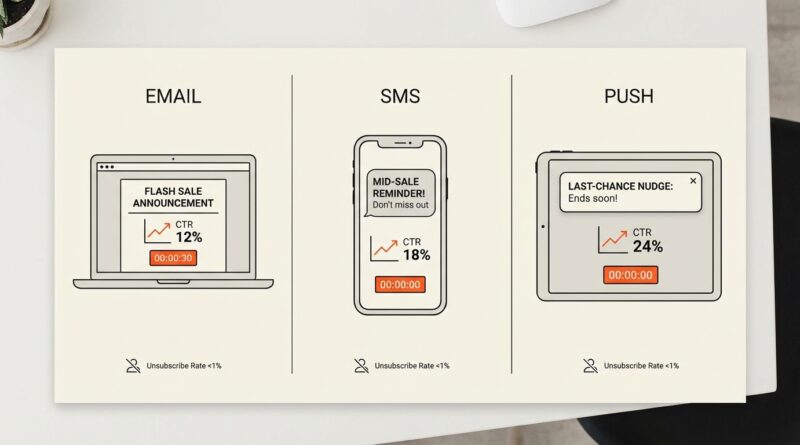
The ‘Channel Handoff’ Flash Sale: How To Stack Email, SMS and Push Without Feeling Like Spam
Flash sales are supposed to feel exciting. But when you line up email, SMS, and push notifications, it can get awkward fast. One message feels helpful. Two feels urgent. Three starts to feel like you are chasing people around the internet with a megaphone. If you have watched unsubscribes creep up after a promo, you are not imagining it. Most brands are not sending too many reminders. They are sending them without a clear handoff between channels.
That is the fix. A good multi channel flash sale strategy email sms push plan does not blast everyone everywhere at once. It lets each channel do a specific job. Email carries the story. SMS handles the high-intent nudge. Push delivers the fast reminder. When you treat channels like teammates instead of clones, your sale can feel urgent without feeling obnoxious. Better still, you get a cleaner read on what actually moved people to buy.
⚡ In a Hurry? Key Takeaways
- Use email first, then hand off to push and SMS based on engagement, not all at once.
- Set one job for each channel: announce, remind, and last-call.
- This keeps urgency high while reducing fatigue, complaints, and unsubscribes.
Why flash sales go wrong so often
The usual mistake is simple. A brand writes one promo message, then copies it into email, SMS, and push within a few hours. Same offer. Same wording. Same countdown. Customers do not experience that as a coordinated campaign. They experience it as repetition.
That repetition is what burns trust. Not the sale itself.
People are fine with urgency when it feels deserved. They get annoyed when every channel says the same thing at the same time. It feels lazy, and it makes your brand sound louder, not smarter.
The better approach is a channel handoff. One channel opens the sale. Another follows up only if needed. A third closes the loop for people who showed intent but did not buy.
The Channel Handoff framework
Think of this like passing a baton in a relay race. One runner starts. The next runner takes over only when it makes sense. That is how you keep the pace up without tripping over yourself.
Step 1: Email announces the sale
Email is still the best place to open a flash sale for most brands. It gives you room to explain the offer, show the product, answer basic objections, and set the time limit clearly.
Your first email should do four things:
- Name the deal in plain English.
- Explain when it starts and ends.
- Show the main product or category.
- Use one clear call to action.
This is your broadest message. Send it to your main eligible audience first. Let email do the heavy lifting.
Step 2: Push reminds the interested group
Push works best as a quick tap on the shoulder. It is not where you explain everything. It is where you say, “Still live. Ends tonight.”
Do not send push to everyone just because you can. Send it to people who:
- Opened the email but did not click.
- Clicked but did not purchase.
- Browsed the product recently.
This is the first real handoff. Email introduced the sale. Push follows up with speed and brevity.
Step 3: SMS closes with the strongest urgency
SMS is your most personal lane. Treat it that way. If email is a storefront sign and push is a sticky note, SMS is a text message from someone you know. That means it should be used more carefully.
SMS is best saved for:
- High-intent subscribers.
- People who clicked but did not check out.
- Last-call moments, usually 4 to 6 hours before the sale ends.
If you send SMS too early, you waste its impact. If you send it to everyone, you train people to ignore it. Keep it tight. Keep it earned.
A simple 24-hour flash sale sequence you can test this week
Here is a practical plug-and-play schedule for a one-day sale.
T minus 0 hours. Launch
Email: “24 hours only: 20% off bestsellers”
Include the offer, the deadline, featured items, and one clear button.
T plus 4 hours. Soft reminder
Push: Send only to people who opened or clicked from email and have not bought.
Example: “Your flash deal is live. Ends tonight.”
T plus 12 hours. Mid-sale nudge
Email: Send a shorter follow-up to non-buyers only.
This one can focus on social proof, low stock, or the single hero product.
T plus 18 to 20 hours. Last call
SMS: Send to opted-in subscribers with strong intent signals.
Example: “Last chance. Your 20% off ends in 4 hours: [link]”
T plus 22 to 23 hours. Final push
Push: Very short. Very clear.
Example: “Ends soon. Final hours.”
That is it. Notice what is missing. No full-list SMS blast. No duplicate message across all channels at launch. No hourly nagging.
How to decide who gets which reminder
This is where smaller brands often overcomplicate things. You do not need a giant data science team. Start with three audience buckets.
Bucket 1: Everyone eligible
Use for the launch email only.
Bucket 2: Engaged but not converted
People who opened, clicked, browsed, or added to cart. These people are good candidates for push and later SMS.
Bucket 3: Bought already
Suppress them from further reminders right away. Nothing kills goodwill faster than texting somebody to buy the thing they already purchased two hours ago.
If your tools support it, add one more filter. Remove anyone who got a promo SMS in the last few days. This simple frequency cap protects you from the “too much, too soon” problem.
What each channel should say
The message should change as the channel changes. That is the whole point.
Email copy style
Use detail. Use images. Use a clear deadline. This is where you explain the value.
Push copy style
Use speed. Keep it under a sentence or two. Focus on timing.
SMS copy style
Use direct language. One benefit. One deadline. One link.
If all three messages sound identical, your campaign will feel repetitive even if the timing is smart.
How to track what actually drove the sale
This is another common pain point. A customer gets the email, sees the push, then buys after the text. Which channel gets credit?
The honest answer is that last-click reporting usually oversimplifies what happened. But you can still get useful answers if you keep your setup clean.
Use channel-specific links
Give email, SMS, and push their own tagged links. Even basic UTM tags help.
Measure assist, not just final click
If email drove most opens and product views, it mattered, even if SMS got the final tap.
Compare unsubscribes and complaint rates by sequence
A campaign that brings in slightly less revenue but cuts opt-outs may be the smarter long-term move.
That is the real win with a multi channel flash sale strategy email sms push setup. You are not just asking, “What sold today?” You are also asking, “What keeps the list healthy for next month?”
Guardrails that keep urgency from turning into spam
You do not need dozens of rules. You need a few good ones that you actually follow.
- Do not send all three channels at launch.
- Suppress buyers immediately after purchase.
- Use SMS last, not first, unless it is a true VIP list.
- Keep flash sales short. Twenty-four hours is plenty.
- Give each channel a different job and different wording.
If you do just those five things, you will already look more organized than most promo calendars out there.
When this works especially well
This framework is a great fit for single-offer promotions. One hero product. One bundle. One limited-time discount. One featured “deal of the day” style campaign.
That matters because focus reduces noise. Customers do not have to decode a whole catalog. They can understand the offer in seconds. That makes each handoff cleaner and more effective.
For smaller merchants, that is a big deal. You can create BFCM-style urgency without needing a giant team or a fancy orchestration platform. Most email and SMS tools already let you build segments, suppress buyers, and stagger sends.
Common mistakes to avoid
Using SMS as a backup loudspeaker
If email underperforms, some brands panic and text everyone. That usually creates a second problem instead of solving the first one.
Ignoring timing windows
A flash sale reminder at 3 a.m. is not urgent. It is annoying.
Forgetting the post-purchase experience
If someone buys, switch them into confirmation and support mode. Do not leave them in promo mode.
Overstuffing the sale
Too many products, too many coupon rules, too many deadlines. Keep it simple enough to explain in one line.
At a Glance: Comparison
| Feature/Aspect | Details | Verdict |
|---|---|---|
| Best for launch, explaining the offer, and reaching the full eligible audience. | Use first. Let it do the main selling. | |
| Push | Best for short reminders to engaged non-buyers during the sale window. | Use as a quick follow-up, not a full pitch. |
| SMS | Best for last-call urgency to opted-in, high-intent shoppers close to deadline. | Use sparingly. Highest impact, highest risk if overused. |
Conclusion
If your flash sale campaign has been feeling a little too much like carpet-bombing, the fix is not to go quiet. It is to get more deliberate. A simple Channel Handoff framework helps smaller brands run hard-hitting, 24-hour promotions with real urgency while keeping complaints and unsubscribes low. That matters right now because everyone is promoting on more channels while inboxes, message apps, and notification trays are already packed. Start with email, hand off to push for interested shoppers, and save SMS for the strongest final nudge. It is practical, easy to test this week with tools you likely already have, and perfect for a single-deal focus where you want to announce, remind, and close without burning trust.