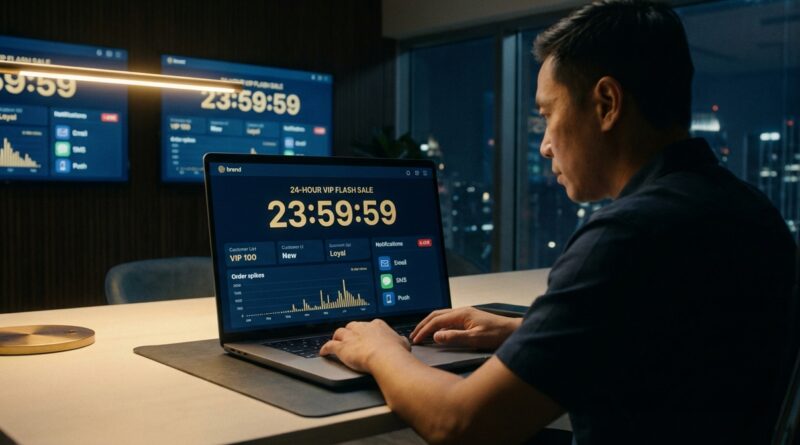
How to Run a 24‑Hour Flash Sale That Feels VIP, Not Spammy
Flash sales go wrong in two very predictable ways. Either a brand hammers everyone with too many “ends tonight” emails until people mute them, or it posts a discount quietly on the site and gets a shrug. If you have ever watched unsubscribe rates spike while sales still feel underwhelming, you are not imagining it. Customers can smell fake urgency a mile away. They are also busy, distracted, and used to fast-moving deals on social platforms. That leaves store owners in a frustrating spot. You need a sale that creates real action without making your brand sound desperate. The good news is that a better 24 hour ecommerce flash sale strategy is surprisingly simple. Pick one clear offer. Send it to the right people first. Keep the countdown honest. Then remind people like a helpful host, not a pushy car alarm. Done right, a 24-hour sale can feel exclusive, clean, and worth acting on.
⚡ In a Hurry? Key Takeaways
- Run one tight 24-hour offer with a real start and stop time, instead of blasting your full list all day.
- Segment your audience, send 3 to 4 well-timed messages max, and make the first access feel earned or exclusive.
- Never fake countdowns or inflate prices before the sale. Short-term bumps are not worth long-term trust damage.
Why most flash sales feel cheap
A bad flash sale usually has one of three problems. The offer is confusing. The audience is too broad. Or the urgency is fake.
If your sale says “up to 60% off select styles” across half the store, most shoppers will not do the math. They will bounce. If you email everyone five times in one day, your warmest subscribers may still buy, but plenty of good customers will get annoyed. And if your timer resets tomorrow, people remember.
The fix is not more noise. It is more clarity.
Start with one offer people can understand in two seconds
The strongest flash sales are easy to repeat out loud. Think:
- 20% off sitewide for 24 hours
- Buy one, get one free on one hero category
- Free gift on orders over a clear threshold
- VIP early access to a limited restock
If a customer has to read the fine print before they understand the value, the offer is too complicated for a one-day event.
Good offer rules
Keep it to one main incentive. Avoid stacking codes, mystery exclusions, and tiny categories nobody wanted anyway. If margins are tight, choose a narrow collection or use a threshold that lifts average order value. A clean offer beats a “bigger” messy one almost every time.
Build the audience in layers, not one giant blast
This is where a smart 24 hour ecommerce flash sale strategy earns its keep. Your whole list does not need the same message at the same time.
Segment 1: VIP customers
Start with your best buyers. Past purchasers. High lifetime value customers. People who opened or clicked recently. Give them first access for a few hours, or at least first notice. That small gesture changes the mood from “we need sales” to “you are on the inside.”
Segment 2: Engaged non-buyers
Next, send to subscribers who have opened emails, browsed products, or added to cart in the last 30 to 60 days. They already know you. They just need a reason to act now.
Segment 3: Wider list
If the sale is performing well, then open it to a broader group. But do not keep mailing people who never engage. That just hurts deliverability and trains inbox providers to ignore you.
A simple rule works well here. Reward attention first. Expand second.
Use a short, calm message plan
You do not need hourly reminders. You need a sequence that respects attention.
A simple 4-message schedule
Email 1, launch: Announce the offer and the end time clearly.
Email 2, mid-sale: Share what is popular, what is back in stock, or who the sale is best for.
Email 3, final hours: A real reminder with the exact closing time.
Email 4, last call, optional: Only to openers, clickers, cart users, or SMS subscribers in the final 2 to 3 hours.
That is enough for most brands.
The key is tone. Write like a person. “Just a quick heads-up, your early access ends at 8 PM.” That works. “FINAL FINAL LAST CHANCE DON’T MISS OUT!!!” does not.
Make the countdown honest
This part matters more than many brands admit. If you say 24 hours, mean 24 hours.
Do not extend the sale the next morning because revenue was soft. Do not reset the timer for every visitor. Do not quietly keep the code live for another week. Those tricks can lift one campaign and weaken the next ten.
Urgency only works when customers believe you.
How to keep it clean
- Show one real end time in the customer’s local timezone if possible
- Use the same deadline across email, SMS, site banner, and checkout
- Turn the code off when the sale ends
- Swap the landing page to a “sale has ended” message, plus a waitlist or browse link
Pick products that fit a one-day event
Not every item should be in a flash sale. The best candidates are:
- Hero products with proven conversion
- Seasonal inventory you genuinely want to move
- Bundles that raise average order value
- Restocks people have been waiting for
The worst candidates are brand-new premium launches you are still trying to position as full-price, evergreen products with very little margin, or random slow movers that make the sale feel like a clearance bin.
Write copy that sounds premium, not panicked
If you want the sale to feel VIP, your words do a lot of the heavy lifting.
Better angles to use
- Private access
- Member-only pricing
- One-day event
- Founder thank-you
- Season change edit
- Limited restock window
Notice what is missing. No fake drama. No guilt trips. No wall of capital letters.
A luxury-leaning brand can say, “For the next 24 hours, our email subscribers have private access to 20% off our core collection.” A playful brand can say, “A quick one. 24 hours. Our best sellers are on sale until midnight.” Both work because they are clear and believable.
Use SMS and social as support, not a siren
Email should usually carry the bulk of the sale. SMS is best used for your hottest segment and your final reminder. Social should reinforce the event for people already paying attention.
A practical channel mix
- Email: Main sales driver and detail layer
- SMS: VIP launch and final-hours nudge
- Instagram Stories or TikTok: Show the products in use, answer questions, remind people of the deadline
- Site banner: Keep the message consistent for all visitors
If you are doing live shopping or short-form video, tie it to the same offer and same deadline. Do not create three different sale messages on three channels. That confuses people fast.
Set up the store before you send a single message
This is the boring part that saves the day.
Your pre-flight checklist
- Test the discount code
- Check mobile checkout flow
- Make sure sale items are in stock
- Confirm product pages show the discount clearly
- Prepare a landing page with the featured products first
- Update customer support macros for common questions
- Schedule the code to expire automatically
A flash sale has very little room for fixing things on the fly. If the code fails, the timer is wrong, or top products are sold out by lunch with no backup plan, trust drops quickly.
What to measure besides revenue
Revenue matters, of course. But if you want to know whether the campaign felt VIP or spammy, look wider.
Healthy signs
- Strong click-through rate from VIP and engaged segments
- Low unsubscribe spike
- Good conversion on the landing page
- Higher average order value if you used bundles or thresholds
- Few support complaints about confusion or expired codes
Warning signs
- Unsubscribes rise sharply after the second or third send
- Open rates fall off a cliff across the day
- Customers ask whether the timer is real
- A lot of traffic hits the site, but the offer is too broad to convert
If the sale makes money but leaves a mess in your list health, take that seriously.
A field-tested one-day playbook you can copy
48 to 72 hours before
Choose one offer. Build the landing page. Set stock rules. Segment your list into VIP, engaged, and broader audiences. Prepare all assets and support replies.
Day before
Tease it lightly to VIPs or on social. Keep it short. “Subscribers get first access tomorrow.” That is enough.
Sale day, morning
Launch to VIPs first if possible. Give them a head start of 2 to 6 hours. Then send to your engaged segment.
Midday
Post social proof. Best sellers. Low-stock alerts only if they are true. Answer questions in stories or comments.
Final hours
Send one clear final reminder. If using SMS, this is the moment. Keep the message useful and specific.
After close
End the code. Remove the banner. Thank customers. Review results by segment, not just total sales. That tells you who responded and who got tired.
Common mistakes to avoid
- Discounting too many products at once
- Sending the same message to your entire list
- Using fake scarcity or recycled countdowns
- Extending the sale after the deadline
- Writing frantic copy that makes the brand sound shaky
- Forgetting the post-sale experience and support follow-up
At a Glance: Comparison
| Feature/Aspect | Details | Verdict |
|---|---|---|
| Offer structure | One clear deal, easy to explain in a sentence, with simple exclusions if any | Best for trust and conversion |
| Audience targeting | VIP first, then engaged subscribers, then broader reach only if needed | Feels exclusive, reduces list fatigue |
| Urgency method | Real 24-hour countdown, fixed deadline, no extensions or fake scarcity | Protects brand equity while still driving action |
Conclusion
Right now, a lot of Shopify and DTC merchants are wrestling with the same question. How do you create urgency without training customers to tune you out? That tension is real. Live shopping, TikTok-style deals, and constant promotions have taught shoppers to move fast, but they have also made them more suspicious of anything that smells fake. The answer is not to go quieter or louder. It is to go cleaner. A simple, field-tested 24 hour ecommerce flash sale strategy uses smart segmentation, one compelling offer, and honest countdowns to drive cash flow without shady price inflation or spray-and-pray emails. That matters even more in March 2026, when ad costs are up and attention is scattered. If every sale has to work harder now, make yours feel like a private event people are happy to join, not an alarm they cannot wait to silence.